How We Know the Universe Is Expanding
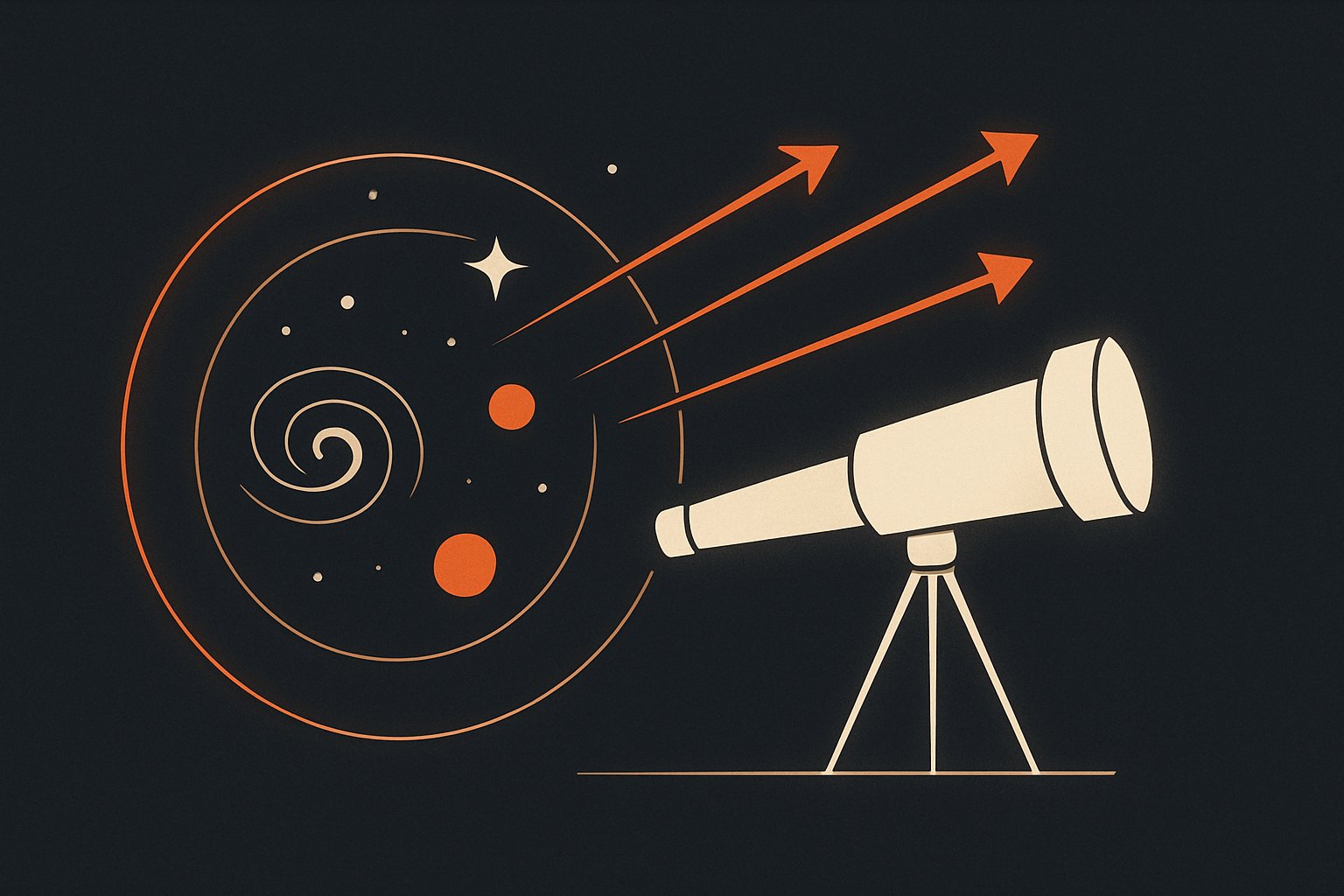
We know the universe is expanding because we observe galaxies moving away from us and their light shifting toward the red end of the spectrum, called redshift.
It's often said that the Big Bang was an explosion from one spot into empty space — in fact, the expansion happened throughout space, so the universe does not have a single central point from which all galaxies are fleeing.
This discovery supports the Big Bang theory and helps scientists understand the origin, age, and future of the universe.
It's like when you hear a siren getting lower in pitch as an ambulance drives away; the light from galaxies shifts in a way that shows they're moving away from us.
Understanding expansion helps explain why astronomers use distant light as a record of the universe's past, rather than a live view of where everything is now.
Suppose an astronomer knows that a particular pattern of light from an atom normally includes a line at 500 nanometers. If a distant galaxy's matching line appears at 510 nanometers, the shifted pattern tells the astronomer that the light's wavelengths were stretched on the way here, and comparing that result with the galaxy's distance helps test the overall expansion of space.
Farther galaxies shift more
In general, the farther away a galaxy is, the more its light is redshifted, showing that space is stretching between galaxies over vast distances.
Light takes time to arrive
Because light travels for so long before reaching Earth, looking at distant galaxies also lets scientists see what the universe was like long ago.
Expansion changes cosmic distances
As space expands, galaxies that are not held together by gravity gradually become farther apart from one another.