Understanding Quantum Entanglement
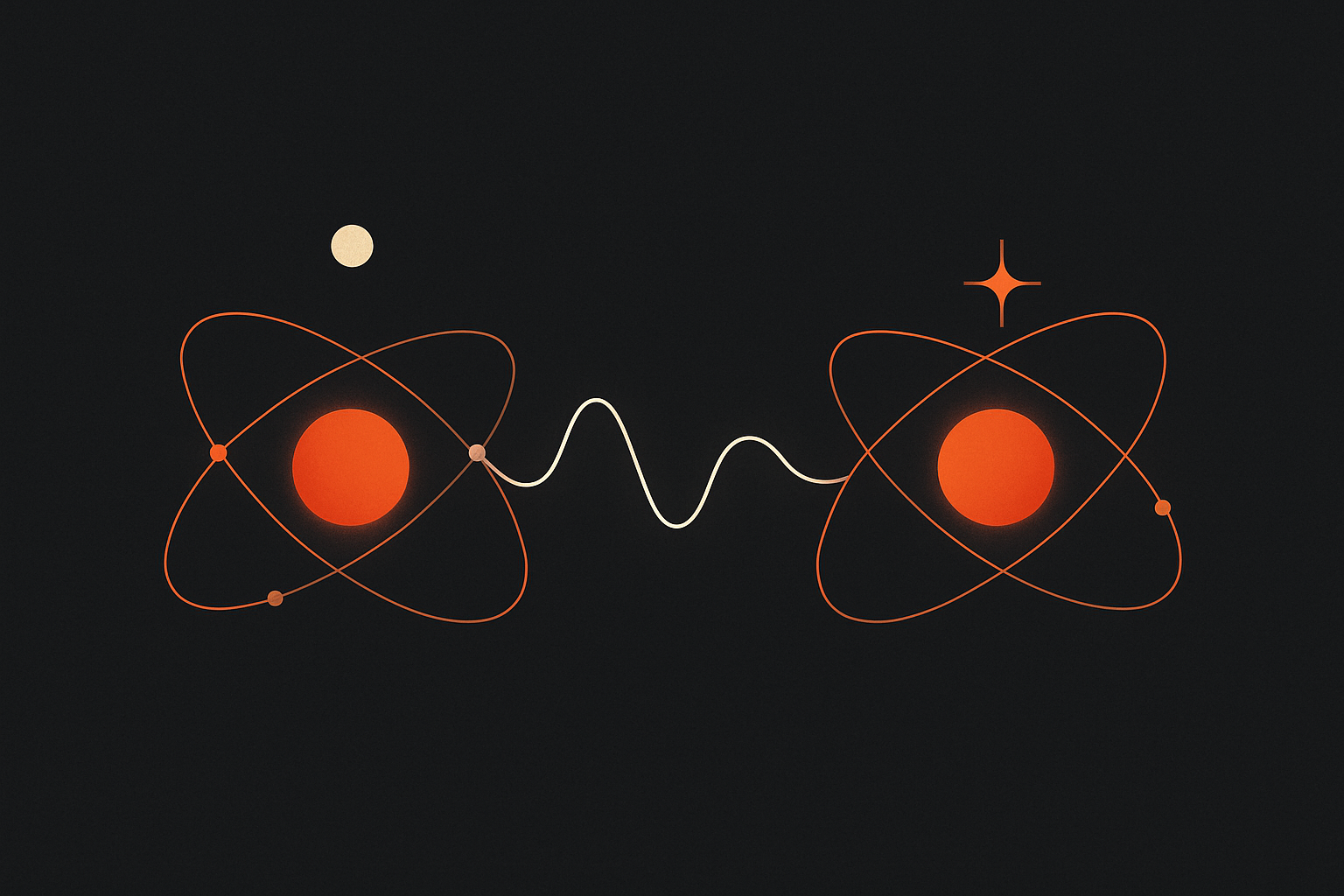
Quantum entanglement is a phenomenon where two or more particles become linked so that the state of one instantly influences the state of the other, no matter the distance between them.
It's often said that entanglement lets people send a chosen message instantly — in fact, each measurement gives an unpredictable result, so useful communication still requires an ordinary way to compare results.
Quantum entanglement challenges our usual ideas about how things should behave and is key to developing new technologies like quantum computers and secure communication.
Imagine you have two magic coins that always show the same side when flipped, even if one is on Earth and the other is on the Moon; that's like quantum entanglement.
Entanglement is moving from a strange idea in physics toward a tool that could shape how information is processed and protected. Understanding it helps make sense of why quantum technology is built differently from ordinary computers and networks.
In a simplified entanglement-based key-sharing setup, Alice and Bob each receive one particle, independently choose how to measure it, and keep only the results from matching choices. They publicly compare a small sample of those results: a clean pattern suggests the particles were undisturbed, while too many mismatches warn them that noise or an eavesdropper may have interfered.
The link starts with interaction
Particles can become entangled when they are created together or interact in ways that connect their properties.
Results are still unpredictable
Entanglement can create matching patterns between particles, even though the result of measuring either individual particle cannot be predicted in advance.
It can protect shared secrets
Quantum communication can use entanglement to reveal interference, helping people detect when someone may have tried to eavesdrop on a message.