What Is a Black Hole
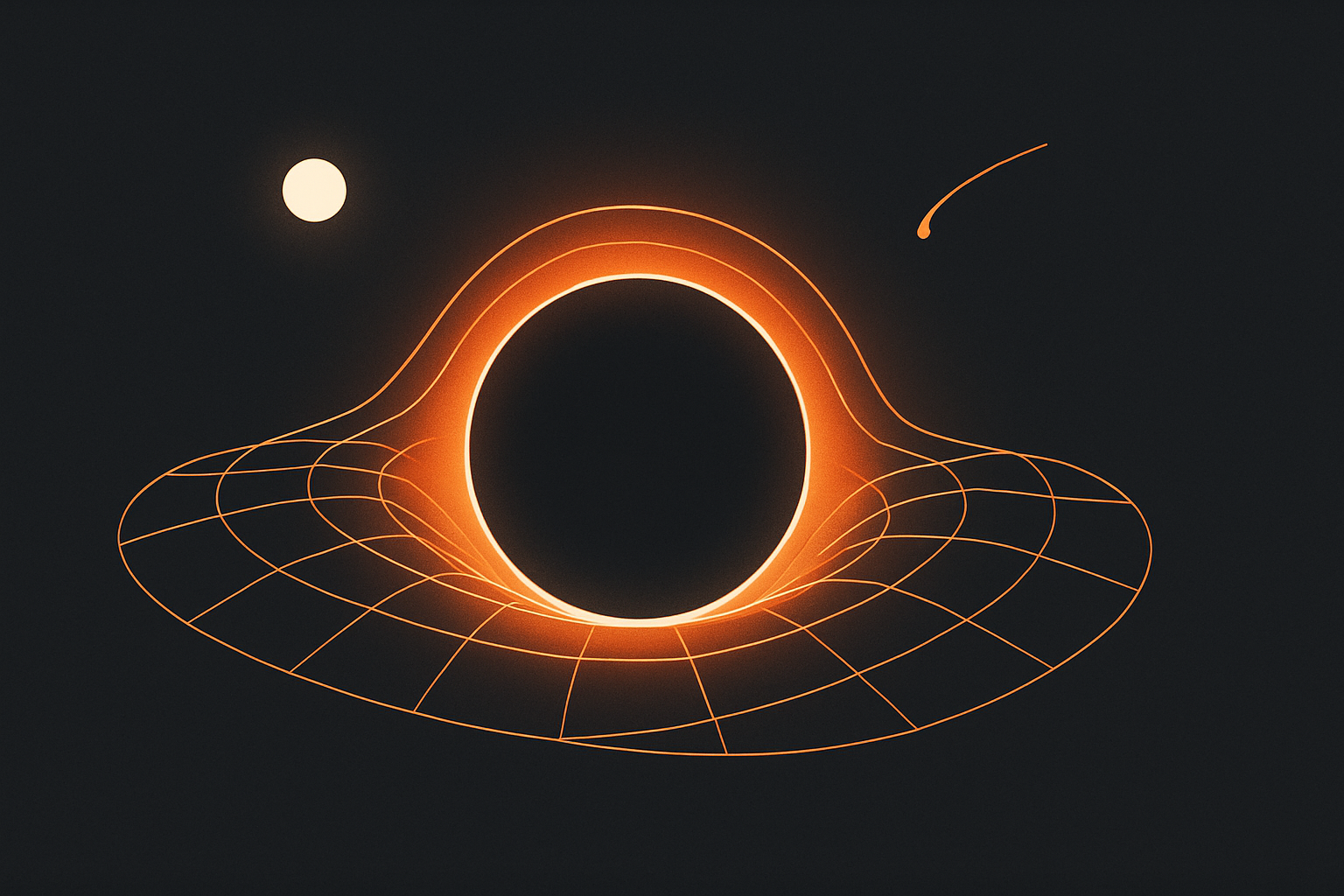
A black hole is a region in space where gravity is so strong that nothing, not even light, can escape from it.
It's often said that a black hole is a literal hole or tunnel through space—in fact, it is a compact region created by matter collapsing under gravity, not an empty opening leading somewhere else.
Black holes help scientists understand how gravity works in extreme conditions and play a key role in the life cycles of stars and galaxies.
Imagine a super powerful vacuum cleaner in space that sucks up everything nearby, even light, so you can't see what's inside.
Black holes are a powerful way to see how the universe connects the tiniest scales of physics with the biggest structures in space. Understanding what they do helps make sense of how stars change and how galaxies grow over time.
Imagine two black holes circling each other in space. Their motion sends ripples through space, carrying away energy, so their orbit gradually shrinks until they merge. A detector can then record the passing ripple as space briefly stretches and squeezes.
They can form from stars
When a very large star runs out of fuel, its core can collapse under its own gravity and become a black hole.
Their edge has a name
The boundary around a black hole is called the event horizon, and once something crosses it, it cannot return.
Scientists spot their effects
Because black holes can pull on nearby gas and stars, scientists can find them by watching how those objects move and glow.