How Soap Carries Grease Away
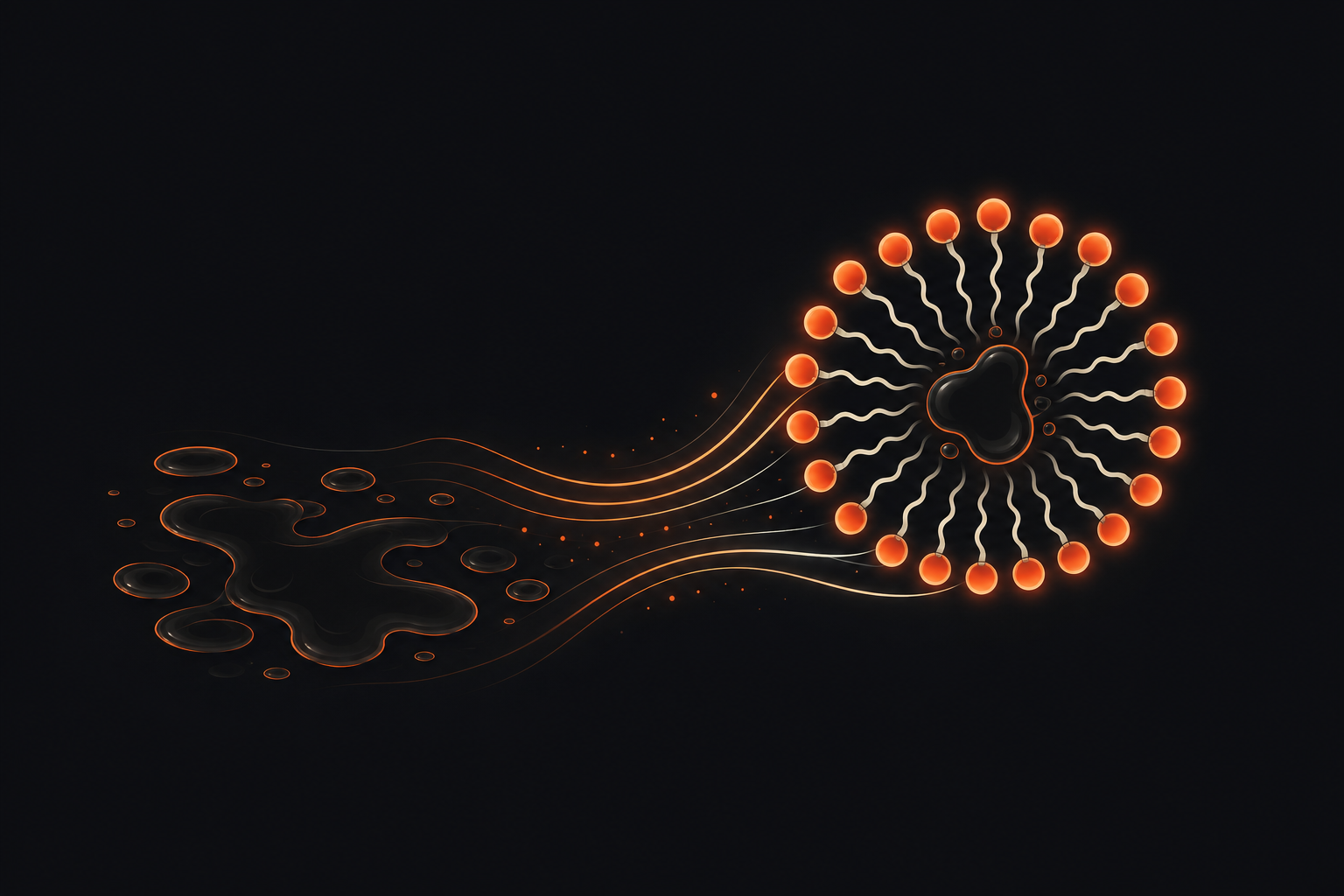
Soap washes grease away because its molecules grab oily dirt with one end and water with the other, forming tiny packets that water can carry off.
Featured in the Friday, October 2 edition →
It's often said that soap dissolves grease — in fact, soap mostly breaks grease into tiny suspended droplets that water can carry away.
This is part of a larger system called surface chemistry, which explains how substances behave where air, water, oil, and solid surfaces meet. The same basic design is used in detergents, emulsions, and some biological processes.
Imagine each soap molecule is a tiny helper with one hand that likes grease and another that likes water. The helpers surround the grease, hold it in little bundles, and let the running water sweep it away.
Understanding this helps whenever you choose a cleaner, wash greasy dishes, or wonder why rinsing alone does not remove oily messes. It also explains why cleaning depends on both the right substance and enough water movement.
Say a pan has a thin layer of cooking oil on it. Soap molecules attach their oil-loving ends to the grease while their water-loving ends face outward, breaking the oil into tiny coated droplets; rinsing then carries those droplets down the drain.
Soap has two different ends
One end is attracted to oily substances while the other interacts easily with water, allowing a single molecule to connect the two.
Scrubbing makes cleaning easier
Heat, rubbing, and soaking help loosen grease from a surface so soap can surround more of it and the rinse water can remove it.
Hard water can weaken soap
Minerals in hard water can react with soap to form an insoluble residue, leaving less soap available to do the cleaning.