A Day Is Longer Than One Rotation
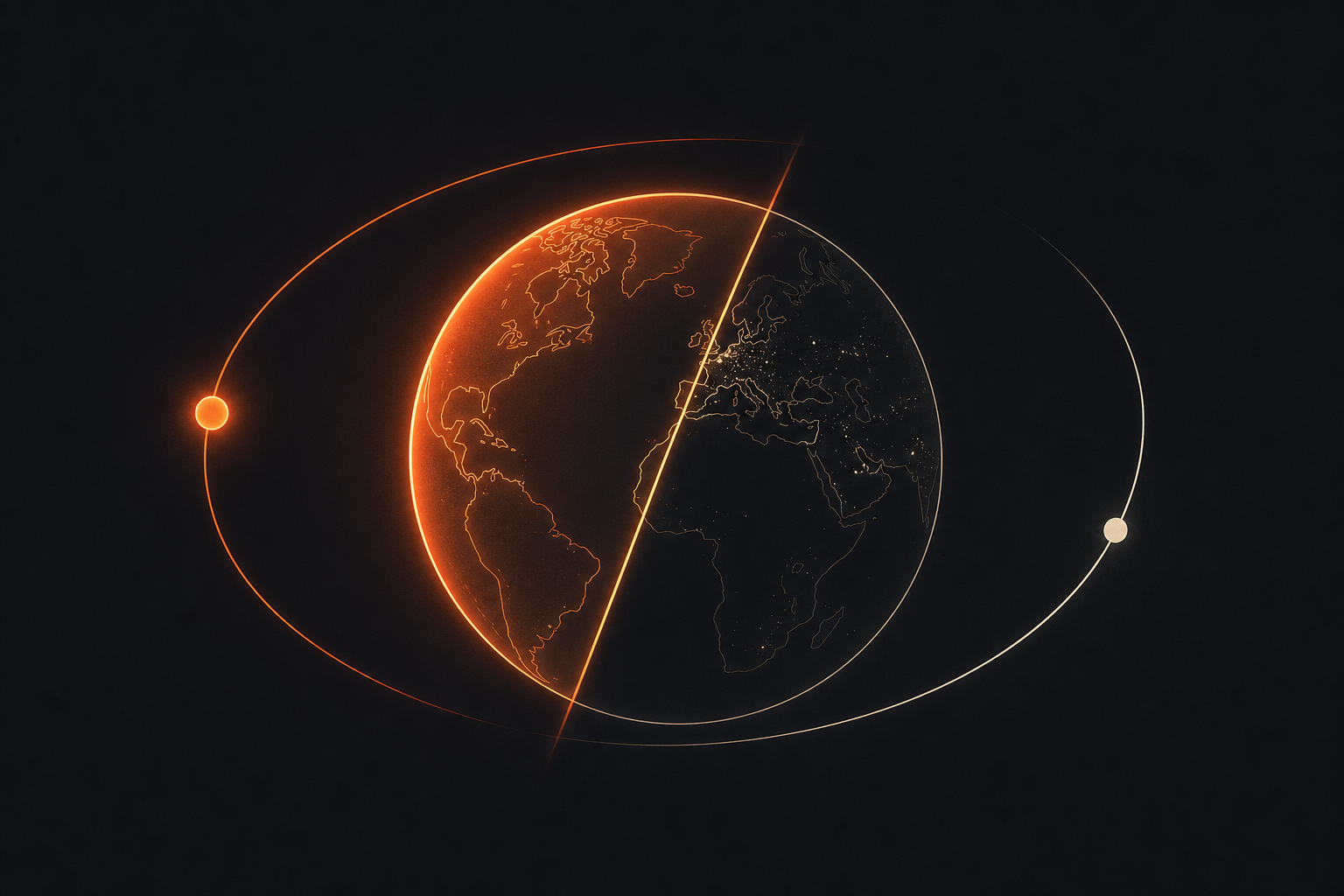
A solar day averages 24 hours, but Earth takes about 23 hours 56 minutes to rotate once relative to the distant stars because it also moves around the Sun.
Featured in the Tuesday, September 29 edition →
It’s often said that Earth’s rotation itself takes exactly 24 hours — in fact, 24 hours is the average time for the Sun to return to the same position in the sky.
Our clocks are built around the Sun’s daily position, not just Earth’s spin, so civil time combines astronomy with systems maintained by national and international timekeepers.
Imagine spinning on a chair while the chair slowly moves around a lamp: you must spin a little extra before the lamp lines up with you again, even though you already made one full turn.
This distinction helps whenever people compare clock time with sunrise, plan observations of the night sky, or wonder why astronomy uses a different kind of day.
Suppose you mark when a particular star passes directly overhead and check again the next time it does so: the repeat takes about 23 hours 56 minutes. During that interval, Earth has moved a little along its orbit, so it must rotate slightly farther for the Sun to reach the same apparent position, making the solar day average 24 hours.
Stars provide the cleaner benchmark
Astronomers use a sidereal day, measured against distant stars, because those stars are so far away that Earth’s orbit barely changes their apparent direction.
The four-minute gap accumulates
A roughly four-minute difference each day adds up to about one full day over a year, which is why the same star-filled sky returns at nearly the same clock time only after a year.
Solar days are not identical
The Sun’s apparent daily schedule shifts slightly through the year because Earth’s orbit is not a perfect circle and its axis is tilted, so 24 hours is an average rather than a perfectly constant interval.